
Fixed income investments represent a cornerstone of diversified portfolios, offering a relatively stable income stream compared to more volatile asset classes like equities. Understanding the nuances of bonds, treasury bills, and other fixed-income securities is crucial for investors seeking to balance risk and return. This guide explores the characteristics, risks, strategies, and market dynamics surrounding fixed income, equipping you with the knowledge to make informed investment decisions.
From defining the core principles of fixed income to analyzing returns and constructing diversified portfolios, we’ll delve into the intricacies of this asset class. We’ll examine various investment strategies, risk mitigation techniques, and the role fixed income plays in achieving long-term financial goals. The goal is to provide a clear and comprehensive understanding of this essential component of successful investing.
Fixed Income Investment Strategies
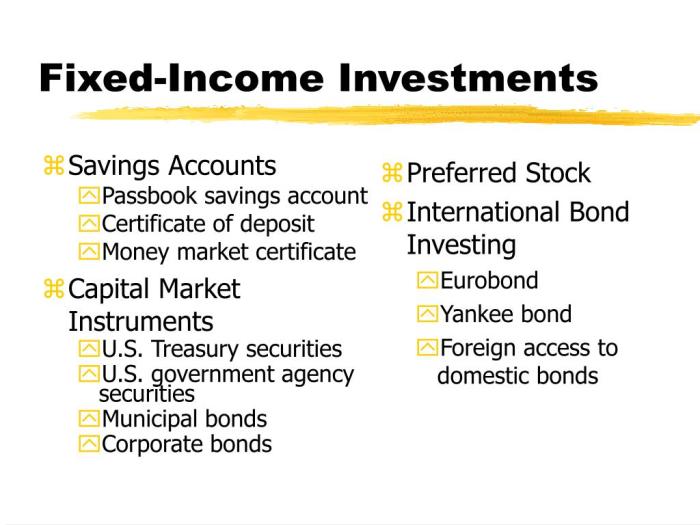
Fixed income investments offer a range of strategies to suit diverse investor goals and risk tolerances. Understanding these strategies is crucial for building a portfolio that aligns with your financial objectives and risk profile. This section explores several popular approaches, comparing active and passive management styles and highlighting the importance of diversification.
Laddering, Barbell, and Bullet Strategies
These strategies focus on managing interest rate risk and maturity. Laddering involves investing in bonds with staggered maturities, reducing the impact of interest rate fluctuations. The barbell strategy divides investments between short-term and long-term bonds, aiming to balance liquidity and yield. A bullet strategy concentrates investments in bonds maturing at a specific date, providing a lump sum payment at that time.
Each strategy offers a unique risk-return profile. For example, laddering provides more consistent cash flow compared to the lump-sum payout of a bullet strategy, while the barbell strategy seeks to capture higher yields from long-term bonds while maintaining liquidity through short-term holdings.
Active versus Passive Fixed Income Management
Active management involves actively selecting individual bonds based on anticipated price movements and yield opportunities. This approach aims to outperform a benchmark index. Passive management, conversely, tracks a specific bond index, mirroring its performance. Active management requires significant expertise and may incur higher fees, while passive management offers simplicity and lower costs. The success of each approach depends on market conditions and the skill of the manager.
For instance, an active manager might successfully outperform a benchmark during periods of significant market volatility, while a passive strategy might be more suitable in stable market conditions where outperformance is less likely.
Diversification in Fixed Income Portfolios
Diversification is essential in managing fixed-income risk. It involves spreading investments across different sectors, maturities, and credit ratings to reduce the impact of losses in any single area. A well-diversified portfolio mitigates the risk of default and interest rate changes. For instance, diversification can reduce the impact of a downgrade in a specific corporate bond by spreading investments across multiple issuers and credit ratings.
This reduces the portfolio’s overall vulnerability to a single negative event.
Constructing a Diversified Fixed Income Portfolio
A diversified fixed-income portfolio typically includes bonds with varying maturities and credit ratings. For example, a portfolio might include short-term government bonds for liquidity, intermediate-term corporate bonds for higher yield, and long-term municipal bonds for tax advantages. The specific allocation depends on individual risk tolerance and investment goals. Consider a portfolio allocating 30% to short-term government bonds (low risk, low yield), 40% to intermediate-term corporate bonds (moderate risk, moderate yield), and 30% to long-term municipal bonds (higher risk, higher yield, tax-advantaged).
This hypothetical example demonstrates how diversification can balance risk and return across different maturities and credit quality. The inclusion of various credit ratings (e.g., AAA, AA, A, BBB) further enhances diversification, mitigating credit risk.
What is Fixed Income?
Fixed income, at its simplest, refers to investments that provide a predictable stream of income over a specified period. The core principle is that you lend money to a borrower (typically a government or corporation) in exchange for regular interest payments and the eventual return of your principal (the original amount lent). This predictability is a key attraction for many investors.Fixed income securities offer a relatively stable return compared to other asset classes, making them a cornerstone of many diversified investment portfolios.
This stability stems from the pre-determined payment schedule, although the actual value of the investment can still fluctuate based on market conditions.
Examples of Fixed Income Investments
Several common investment vehicles fall under the umbrella of fixed income. Government bonds, for instance, represent a loan made to a government entity. These bonds typically offer lower returns than corporate bonds but are generally considered less risky due to the perceived higher creditworthiness of governments. Corporate bonds, on the other hand, are debt securities issued by companies to raise capital.
These often offer higher yields to compensate for the increased risk of default. Another example is certificates of deposit (CDs), which are time deposits offered by banks, paying a fixed interest rate over a specific term. Each of these provides a known interest payment schedule, thus qualifying as a fixed income investment.
Fixed Income versus Variable Income
The key difference between fixed income and variable income investments lies in the predictability of returns. Fixed income investments, as discussed, offer a predetermined payment schedule. Variable income investments, such as stocks, do not guarantee any specific income stream. Instead, returns are dependent on the performance of the underlying asset, which can fluctuate significantly. For example, a stock may pay dividends, but the amount and frequency of these dividends can vary, and the stock price itself is subject to market forces.
Therefore, while fixed income investments aim for consistent income, variable income investments aim for capital appreciation, with income often being a secondary consideration. This fundamental difference dictates the risk profile and investment strategy associated with each asset class.
Mastering fixed income investments requires a nuanced understanding of risk, return, and market dynamics. By carefully considering factors such as interest rate sensitivity, creditworthiness, and diversification strategies, investors can effectively integrate fixed income into their portfolios to enhance stability and achieve their financial objectives. This guide has provided a foundation for navigating the complexities of this important asset class, empowering you to make informed choices and build a robust investment strategy.
Answers to Common Questions
What is the difference between a coupon rate and a yield?
The coupon rate is the fixed interest rate stated on a bond, while the yield represents the actual return an investor receives, which can fluctuate based on market conditions and the bond’s price.
How are fixed income investments taxed?
Taxation on fixed income investments varies depending on the type of security and the investor’s jurisdiction. Interest income from most bonds is typically taxable, but specific rules and exemptions may apply.
Are fixed income investments suitable for all investors?
Fixed income investments can be a valuable part of many portfolios, but their suitability depends on individual investment goals, risk tolerance, and time horizon. Consult with a financial advisor to determine if they align with your specific circumstances.
What is reinvestment risk?
Reinvestment risk refers to the risk that future coupon payments from a bond may need to be reinvested at a lower interest rate than the original coupon rate.


