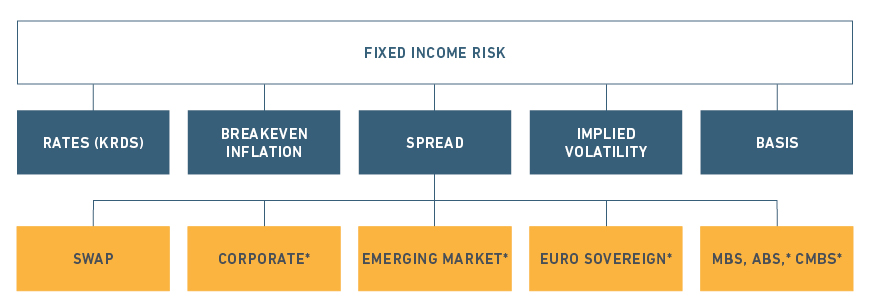
Navigating the complexities of fixed income investments requires a robust understanding of inherent risks. From interest rate fluctuations to credit defaults and liquidity crunches, the potential for loss is ever-present. Effective fixed income risk management isn’t merely about minimizing losses; it’s about strategically optimizing portfolio returns while maintaining a desired risk profile. This exploration delves into the core principles and practical applications of managing these risks, equipping investors with the knowledge to make informed decisions.
This comprehensive guide provides a framework for understanding and mitigating various fixed income risks. We’ll examine different risk types, explore portfolio construction strategies, and delve into sophisticated risk measurement and mitigation techniques. Furthermore, we will discuss the regulatory landscape and compliance requirements essential for responsible fixed income investing.
Introduction to Fixed Income Risk Management
Fixed income risk management is the process of identifying, measuring, and mitigating the risks associated with investing in fixed-income securities. It involves a comprehensive assessment of potential losses and the implementation of strategies to protect portfolio value and achieve investment objectives. Effective management is crucial for ensuring the stability and long-term success of any portfolio heavily invested in bonds or other fixed-income instruments.Fixed income risk management plays a vital role in portfolio construction by enabling investors to make informed decisions, optimize returns, and control risk exposure.
By carefully analyzing the various risks associated with different fixed-income securities, investors can build diversified portfolios that align with their risk tolerance and investment goals. A well-managed fixed-income portfolio is less susceptible to significant losses during market downturns and can provide a stable foundation for overall investment performance.
Types of Fixed Income Securities and Associated Risks
Fixed-income securities encompass a wide range of instruments, each with its own unique risk profile. Understanding these risks is fundamental to effective portfolio management.
For example, Government bonds, issued by national governments, are generally considered low-risk due to the backing of the issuing government. However, they are still subject to interest rate risk (changes in market interest rates impacting bond prices) and inflation risk (the erosion of purchasing power due to rising inflation). A rise in interest rates would typically lead to a fall in the price of existing bonds, while high inflation can diminish the real return of a bond.
Corporate bonds, issued by companies, carry higher risk than government bonds because they are subject to the creditworthiness of the issuer. Credit risk (the risk of default by the issuer) is a significant concern for corporate bonds. The risk of default is higher for lower-rated bonds, which often offer higher yields to compensate for the increased risk. Additionally, corporate bonds are also subject to interest rate risk and market risk (fluctuations in bond prices due to broader market factors).
Mortgage-backed securities (MBS), which are bundles of mortgages, carry risks associated with prepayment risk (borrowers paying off their mortgages earlier than expected) and interest rate risk. Prepayment risk can negatively impact returns if interest rates fall and borrowers refinance at lower rates. These securities are also sensitive to changes in the housing market and broader economic conditions.
Finally, municipal bonds, issued by state and local governments, offer tax advantages but also carry credit risk and interest rate risk. The creditworthiness of the issuing municipality is a key factor in determining the risk of a municipal bond. Furthermore, these bonds are also sensitive to changes in interest rates and general economic conditions.
Types of Fixed Income Risks
Investing in fixed income securities, while generally considered less volatile than equities, exposes investors to a range of risks that can significantly impact returns. Understanding these risks is crucial for effective portfolio management and risk mitigation. This section will detail several key types of fixed income risks.
Interest Rate Risk
Interest rate risk is the risk that the value of a fixed-income security will decline in response to increases in overall interest rates. This risk is most pronounced for bonds with longer maturities and lower coupon payments. The sensitivity of a bond’s price to interest rate changes is measured by its duration and convexity.Duration measures the weighted average time until a bond’s cash flows are received.
A higher duration indicates greater sensitivity to interest rate changes. For example, a bond with a duration of 5 years will experience a larger price change for a given interest rate shift than a bond with a duration of 2 years. Convexity captures the non-linear relationship between bond prices and interest rates. While duration provides a linear approximation, convexity accounts for the curvature of the price-yield relationship, offering a more precise measure of interest rate sensitivity, particularly for larger interest rate movements.
A bond with higher convexity will experience a smaller price decline for an interest rate increase and a smaller price increase for an interest rate decrease compared to a bond with lower convexity.
Credit Risk
Credit risk, also known as default risk, is the risk that the issuer of a fixed-income security will fail to make timely interest or principal payments. This risk is inherent in all debt securities, although the level of risk varies considerably depending on the creditworthiness of the issuer. Credit risk assessment involves evaluating the issuer’s financial strength, operating performance, and overall business prospects.
Rating agencies such as Moody’s, S&P, and Fitch provide credit ratings that reflect the perceived level of credit risk. A downgrade in credit rating signals an increased likelihood of default, leading to a decline in the bond’s price. Downgrade risk, therefore, is a component of overall credit risk and represents the potential for a decline in credit rating and subsequent increase in yield spread.
Liquidity Risk
Liquidity risk refers to the risk that a fixed-income security cannot be readily bought or sold without significantly impacting its price. This risk is particularly relevant for less actively traded bonds or those issued by smaller or less well-known entities. A lack of liquidity can force investors to accept lower prices to sell their bonds quickly, resulting in losses.
Factors contributing to liquidity risk include the size and depth of the market for a particular security, the overall market conditions, and the investor’s ability to hold the bond until maturity.
Reinvestment Risk
Reinvestment risk is the risk that an investor will not be able to reinvest coupon payments or principal repayments at the same rate as the original investment. This risk is most significant when interest rates are falling. For example, if an investor receives a coupon payment from a bond yielding 5%, but interest rates have subsequently fallen to 3%, the investor will only be able to reinvest the coupon payment at the lower rate, reducing their overall return.
Inflation Risk
Inflation risk, or purchasing power risk, is the risk that inflation will erode the real value of future cash flows from a fixed-income security. If inflation rises faster than the bond’s yield, the investor’s real return will be lower than expected. This is because the purchasing power of the bond’s payments decreases as prices rise. For example, if a bond yields 4% but inflation is 5%, the investor experiences a negative real return of 1%.
Investors often consider inflation-indexed bonds, which adjust their principal and coupon payments based on inflation, to mitigate this risk.
| Risk Type | Definition | Measurement | Mitigation Strategies |
|---|---|---|---|
| Interest Rate Risk | Risk that bond prices will decline due to rising interest rates. | Duration, Convexity, DV01 | Diversification, hedging with interest rate derivatives, shorter maturity bonds. |
| Credit Risk | Risk that the issuer will default on its obligations. | Credit ratings, default probabilities, spread analysis | Diversification across issuers and credit ratings, credit default swaps. |
| Liquidity Risk | Risk that a bond cannot be easily bought or sold without significant price impact. | Bid-ask spreads, trading volume, market depth | Investing in liquid bonds, diversification, maintaining sufficient cash reserves. |
Fixed Income Portfolio Construction and Strategies
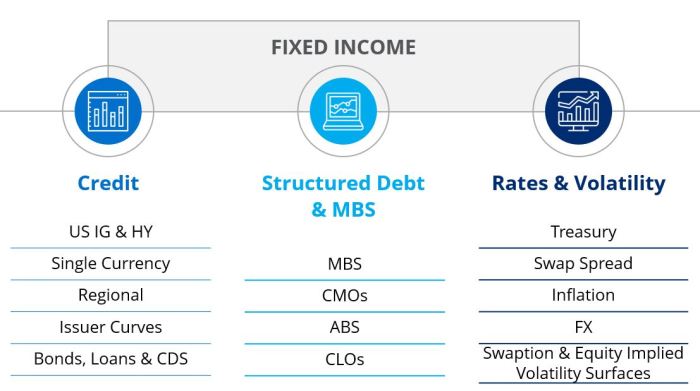
Constructing a fixed income portfolio involves carefully balancing risk and return objectives. The specific strategies employed depend heavily on the investor’s risk tolerance, time horizon, and overall financial goals. Several key approaches exist, each with its own strengths and weaknesses.
Fixed Income Portfolio Construction Strategies
Different strategies exist for constructing fixed income portfolios, each tailored to specific investor needs. Immunization strategies aim to protect against interest rate risk, while dedication strategies focus on meeting predetermined cash flow requirements. Other approaches, such as laddering and barbell strategies, offer diversified exposures to different maturities and risk levels.
- Immunization: This strategy aims to protect the portfolio’s value from interest rate fluctuations. It involves matching the duration of the portfolio’s assets to the investor’s liability horizon. This ensures that changes in interest rates have a minimal impact on the portfolio’s ability to meet future obligations. For example, an insurance company with future payouts might immunize its bond portfolio to ensure it can meet those obligations regardless of interest rate movements.
- Dedication: This strategy focuses on meeting specific future cash flow needs. The portfolio is constructed to generate cash flows that precisely match the timing and amount of future liabilities. A common example is a pension fund manager who needs to make regular payments to retirees; they might use a dedication strategy to ensure sufficient funds are available at the appropriate times.
- Laddering: This strategy involves diversifying across maturities by investing in bonds with staggered maturity dates. This reduces interest rate risk compared to holding only short-term or long-term bonds. For instance, a portfolio might include bonds maturing in 1, 2, 3, and 5 years, spreading the risk of interest rate changes.
- Barbell Strategy: This involves investing in both short-term and long-term bonds, while avoiding intermediate-term bonds. This strategy aims to benefit from both the stability of short-term bonds and the higher yield potential of long-term bonds. It offers a balance between liquidity and yield, mitigating some interest rate risk.
Sample Fixed Income Portfolio
Let’s design a sample portfolio for a moderately risk-averse investor with a five-year time horizon and a target return of 4% annually. The investor seeks capital preservation and stable income. Diversification will be achieved through a combination of government bonds, high-quality corporate bonds, and a small allocation to mortgage-backed securities.
| Asset Class | Allocation | Rationale |
|---|---|---|
| U.S. Treasury Bonds (various maturities) | 60% | Provides safety and liquidity, forming the core of the portfolio. |
| Investment-Grade Corporate Bonds | 30% | Offers higher yields than Treasuries while maintaining a relatively low risk profile. |
| Agency Mortgage-Backed Securities | 10% | Adds diversification and potentially higher yield, but with slightly increased risk. |
This portfolio aims for a balance between safety and return. The longer-term Treasury bonds provide stability, while the corporate bonds offer higher yields. The small allocation to mortgage-backed securities adds diversification and potential for slightly higher returns. This is a simplified example; a real-world portfolio would involve more detailed security selection and ongoing monitoring.
Active vs. Passive Fixed Income Management
Active and passive management represent contrasting approaches to fixed income investing. Active management involves attempting to outperform a benchmark index through skillful security selection and market timing. Passive management aims to replicate the performance of a specific index, minimizing costs and tracking error.
- Active Management: Active managers use fundamental analysis, technical analysis, and macroeconomic forecasts to identify undervalued bonds or anticipate market movements. They aim to generate alpha, or excess returns above the benchmark. However, active management typically incurs higher fees and may not always succeed in outperforming the market.
- Passive Management: Passive managers construct portfolios that closely track a specific index, such as the Barclays Aggregate Bond Index. This approach typically involves lower fees and simpler portfolio construction. Passive management aims to achieve market returns, without attempting to beat the market consistently.
The choice between active and passive management depends on the investor’s resources, risk tolerance, and investment goals. Investors with a long-term horizon and lower risk tolerance may prefer passive management, while those with a higher risk tolerance and the resources to pay higher fees might consider active management.
Risk Measurement and Modeling Techniques
Effective risk management in fixed income necessitates robust measurement and modeling techniques to quantify and understand potential losses. These techniques allow portfolio managers to make informed decisions, optimize portfolios, and comply with regulatory requirements. This section explores key methods used to assess and manage fixed income risk.
Value at Risk (VaR) and Expected Shortfall (ES) in Fixed Income Risk Management
Value at Risk (VaR) and Expected Shortfall (ES) are crucial tools for quantifying potential losses in a portfolio over a specific time horizon and confidence level. VaR answers the question: “What is the maximum loss I can expect to experience with a given probability?” ES, also known as Conditional Value at Risk (CVaR), provides a more comprehensive measure by calculating the expected loss in the worst-case scenarios beyond the VaR threshold.
For example, a VaR of $1 million at a 95% confidence level indicates that there is a 5% chance of losing at least $1 million. ES, on the other hand, would calculate the average loss among those worst 5% of scenarios. Both VaR and ES are widely used in fixed income risk management, helping to set appropriate risk limits and allocate capital effectively.
The choice between VaR and ES often depends on the regulatory requirements and the risk appetite of the institution. Sophisticated models incorporating correlations between assets and interest rate scenarios are often employed to calculate accurate VaR and ES figures for fixed income portfolios.
Duration and Convexity in Measuring Interest Rate Risk
Duration and convexity are fundamental measures of interest rate risk. Duration measures the sensitivity of a bond’s price to changes in interest rates. It essentially tells us how much the price of a bond will change for a given change in interest rates. Convexity captures the curvature of the relationship between bond prices and interest rates. This is crucial because the linear relationship approximated by duration breaks down for larger interest rate changes.
A higher convexity implies greater price appreciation when interest rates fall and smaller price depreciation when interest rates rise. For example, a bond with a duration of 5 years and a positive convexity will experience a price decrease of approximately 5% if interest rates increase by 1 percentage point, but the actual price change will be slightly less than 5% due to the positive convexity effect.
The calculation of duration and convexity involves complex mathematical formulas that consider the bond’s cash flows and yield to maturity. These metrics are essential for constructing and managing interest rate risk-sensitive portfolios.
Monte Carlo Simulations for Fixed Income Portfolio Risk Assessment
Monte Carlo simulations are powerful tools for assessing the risk of fixed income portfolios. These simulations involve generating a large number of possible future interest rate scenarios, based on historical data and/or stochastic models. For each scenario, the portfolio’s value is calculated, allowing the distribution of potential portfolio values to be generated. This provides a much richer picture of risk than simply using point estimates like duration and VaR.
For instance, a Monte Carlo simulation might generate 10,000 different interest rate paths over a 10-year horizon, each with a corresponding portfolio value. Analyzing the distribution of these 10,000 portfolio values allows for the estimation of various risk measures, including VaR, ES, and the probability of significant losses. The flexibility of Monte Carlo simulations allows for the incorporation of various factors affecting fixed income instruments, such as changes in credit spreads, prepayment rates, and currency fluctuations.
This makes it a versatile tool for managing a wide range of risks in complex fixed income portfolios.
Risk Mitigation Techniques
Effective risk management in fixed income is crucial for achieving investment objectives while minimizing potential losses. This section details strategies for mitigating the three primary risks: interest rate risk, credit risk, and liquidity risk. A multi-faceted approach, incorporating various techniques, is generally necessary to achieve a robust risk mitigation framework.
Hedging Interest Rate Risk
Interest rate risk, the risk that the value of a fixed income security will decline due to changes in interest rates, is a significant concern for many investors. Hedging strategies aim to offset these potential losses. The choice of hedging strategy depends on the investor’s specific circumstances and risk tolerance.
- Interest Rate Swaps: These contracts allow investors to exchange fixed-rate interest payments for floating-rate payments, or vice versa. This can effectively transform a portfolio’s interest rate exposure. For example, an investor holding a portfolio of fixed-rate bonds might enter into a receive-fixed/pay-floating swap to hedge against rising interest rates. The floating rate payments would offset potential losses on the fixed-rate bonds.
- Futures Contracts: Trading in interest rate futures contracts allows investors to lock in a future interest rate. Buying futures contracts can protect against rising interest rates, while selling them can protect against falling rates. For instance, an investor expecting interest rates to rise might buy Treasury bond futures contracts to lock in a favorable yield.
- Options on Interest Rate Futures: Options provide flexibility. Buying put options on interest rate futures protects against rising interest rates, while buying call options protects against falling rates. This approach allows investors to define their maximum loss and participate in potential gains.
Credit Risk Mitigation Techniques
Credit risk, the risk of default by the issuer of a fixed-income security, is another key concern. Diversification and credit derivatives are essential tools for mitigating this risk.Diversification involves spreading investments across multiple issuers and industries to reduce the impact of a single default. This reduces the concentration risk associated with holding a large position in a single issuer’s debt.
- Credit Default Swaps (CDS): A CDS is a derivative contract that transfers credit risk from one party (the protection buyer) to another (the protection seller). The buyer pays a premium to the seller in exchange for protection against a default event by a reference entity. If the reference entity defaults, the seller compensates the buyer for the losses incurred. For example, an investor holding corporate bonds might purchase a CDS to protect against the issuer defaulting on its obligations.
Managing Liquidity Risk
Liquidity risk, the risk that an asset cannot be easily bought or sold without significantly impacting its price, is a critical consideration. Maintaining sufficient liquidity is essential to meet unexpected obligations and capitalize on investment opportunities.
- Maintaining Sufficient Cash Reserves: Holding a sufficient amount of highly liquid assets, such as cash and short-term government securities, ensures the ability to meet immediate obligations and unexpected expenses. The appropriate level of cash reserves depends on factors such as the investor’s investment horizon and risk tolerance.
- Utilizing Short-Term Investments: Investing in short-term, highly liquid securities such as Treasury bills or commercial paper provides a buffer against unexpected liquidity needs while still generating some return. These investments can be easily converted to cash when necessary.
Regulatory and Compliance Aspects
Effective fixed income risk management necessitates a thorough understanding and adherence to the complex regulatory and compliance landscape. This framework aims to protect investors, maintain market stability, and prevent systemic risk. Failure to comply can lead to significant financial penalties and reputational damage.The regulatory framework governing fixed income risk management is multifaceted and varies across jurisdictions. However, common themes include capital adequacy requirements, reporting obligations, and conduct rules.
These regulations often stem from international accords like Basel III, which sets minimum capital requirements for banks, and are further implemented and adapted by individual countries or regions through their own specific legislation and supervisory guidance. For instance, the Securities and Exchange Commission (SEC) in the United States plays a pivotal role in regulating fixed income securities and the firms that deal with them.
Similarly, the European Securities and Markets Authority (ESMA) performs a similar function within the European Union.
Capital Adequacy Requirements
Capital adequacy requirements dictate the minimum amount of capital a financial institution must hold to absorb potential losses from its fixed income investments. These requirements are risk-weighted, meaning that higher-risk investments necessitate a larger capital buffer. For example, a highly leveraged position in long-term government bonds would typically require a lower capital buffer than a comparable position in high-yield corporate bonds.
These calculations are complex and often involve sophisticated internal models approved by regulators. Failure to meet these requirements can lead to regulatory action, including restrictions on business activities or even insolvency.
Reporting Obligations
Financial institutions are subject to various reporting obligations related to their fixed income portfolios. These reports provide regulators with insights into the institution’s risk profile and allow for monitoring of systemic risks within the financial system. Reports often include details on the composition of the portfolio, the level of risk exposure, and the effectiveness of risk management strategies.
These reports must be submitted regularly and often with strict deadlines. The specific reporting requirements vary depending on the institution’s size, the nature of its operations, and the jurisdiction in which it operates. Non-compliance can result in fines and other penalties.
Internal Controls
Robust internal controls are crucial for ensuring effective fixed income risk management. These controls encompass a range of measures designed to prevent, detect, and mitigate risks. Key elements include independent risk assessment functions, strong governance structures, comprehensive risk policies and procedures, and regular internal audits. A well-defined escalation process for reporting and addressing exceptions is also essential.
For example, a clear escalation path for reporting breaches of internal risk limits is crucial for preventing losses from escalating. Effective internal controls enhance transparency and accountability, which in turn builds confidence among investors and regulators.
Fixed Income
Fixed income securities represent a core component of many investment portfolios, offering a predictable stream of income and, in some cases, capital appreciation. Understanding their characteristics and the nuances of different types is crucial for effective risk management. This section will define fixed income securities, compare various types, and highlight key features through a tabular summary.Fixed income securities are debt instruments that promise a predetermined stream of payments to the investor over a specified period.
These payments, typically in the form of interest (coupon payments), are made at regular intervals, and the principal amount is repaid at maturity. The return profile of fixed income securities is generally less volatile than that of equities, making them attractive to investors seeking lower risk. However, they are still subject to various risks, as detailed in previous sections.
Types of Fixed Income Securities
This section compares and contrasts several common types of fixed income securities, emphasizing their key differences in terms of risk and return profiles. Understanding these differences is crucial for portfolio diversification and risk mitigation.Government bonds are issued by national governments to finance their spending. They are generally considered to be the least risky fixed income securities because of the backing of the government’s taxing power.
Corporate bonds, on the other hand, are issued by corporations to raise capital for various purposes. They carry a higher risk of default than government bonds, as the issuer’s ability to repay the debt depends on its financial health. Mortgage-backed securities (MBS) are securities backed by a pool of mortgages. Their value and returns are directly influenced by the performance of the underlying mortgages, making them susceptible to interest rate changes and defaults on the mortgages themselves.
Key Features of Fixed Income Securities
The following table summarizes the key features of different fixed income securities. Note that these are general characteristics, and specific features can vary significantly based on the individual security.
| Security Type | Maturity (Typical Range) | Coupon Rate (Typical Range) | Credit Rating (Typical Range) |
|---|---|---|---|
| Government Bonds (e.g., U.S. Treasury Bonds) | 10-30 years | Variable, often reflecting prevailing interest rates | AAA (highest) |
| Corporate Bonds (Investment Grade) | 1-30 years | Variable, higher than government bonds to compensate for higher risk | BBB- to AAA |
| Corporate Bonds (High-Yield) | 1-10 years | Significantly higher than investment-grade bonds to compensate for high default risk | BB+ and below |
| Mortgage-Backed Securities (MBS) | Variable, depending on the underlying mortgages | Variable, often linked to prevailing interest rates | Variable, depending on the underlying mortgages and the issuer |
Mastering fixed income risk management is crucial for achieving long-term investment success. By understanding the intricacies of interest rate risk, credit risk, and liquidity risk, and by employing appropriate mitigation strategies, investors can significantly enhance their portfolio’s resilience and potential for growth. This guide has provided a foundational understanding, equipping you with the tools to navigate the challenges and opportunities within the fixed income market.
Remember that continuous learning and adaptation are key to navigating this dynamic landscape effectively.
Frequently Asked Questions
What is the difference between duration and convexity?
Duration measures a bond’s price sensitivity to interest rate changes. Convexity refines this measure by accounting for the non-linear relationship between bond prices and yields, providing a more accurate risk assessment for larger yield changes.
How can I use stress testing in fixed income risk management?
Stress testing involves simulating extreme market scenarios (e.g., sharp interest rate hikes, widespread defaults) to assess a portfolio’s resilience and identify potential vulnerabilities. This helps proactively develop contingency plans.
What role does diversification play in fixed income risk management?
Diversification across different bond types (e.g., government, corporate, municipal), maturities, and issuers reduces the impact of losses from any single investment, promoting overall portfolio stability.
What are some examples of active fixed income management strategies?
Active strategies include sector rotation (shifting investments based on economic forecasts), yield curve trading (profiting from changes in yield curve shapes), and relative value trading (exploiting price discrepancies between similar bonds).


